
As an ambitious coach, you’ve known for a long time: Generic standard training zones are descriptive, not prescriptive. You would never train a “sprinter” (with a high VLamax) and a “diesel” (with a low VLamax) exactly the same way, just because they have the same FTP. While one burns fat comfortably in “Zone 2”, the other is already massively depleting their glycogen stores at the exact same percentage of intensity. That is why you use an individual metabolic profile for precise control to unlock your athletes’ true potential.
But if you rely on the highest level of individualization and control in your training—why do you leave your business to generic, standard software?
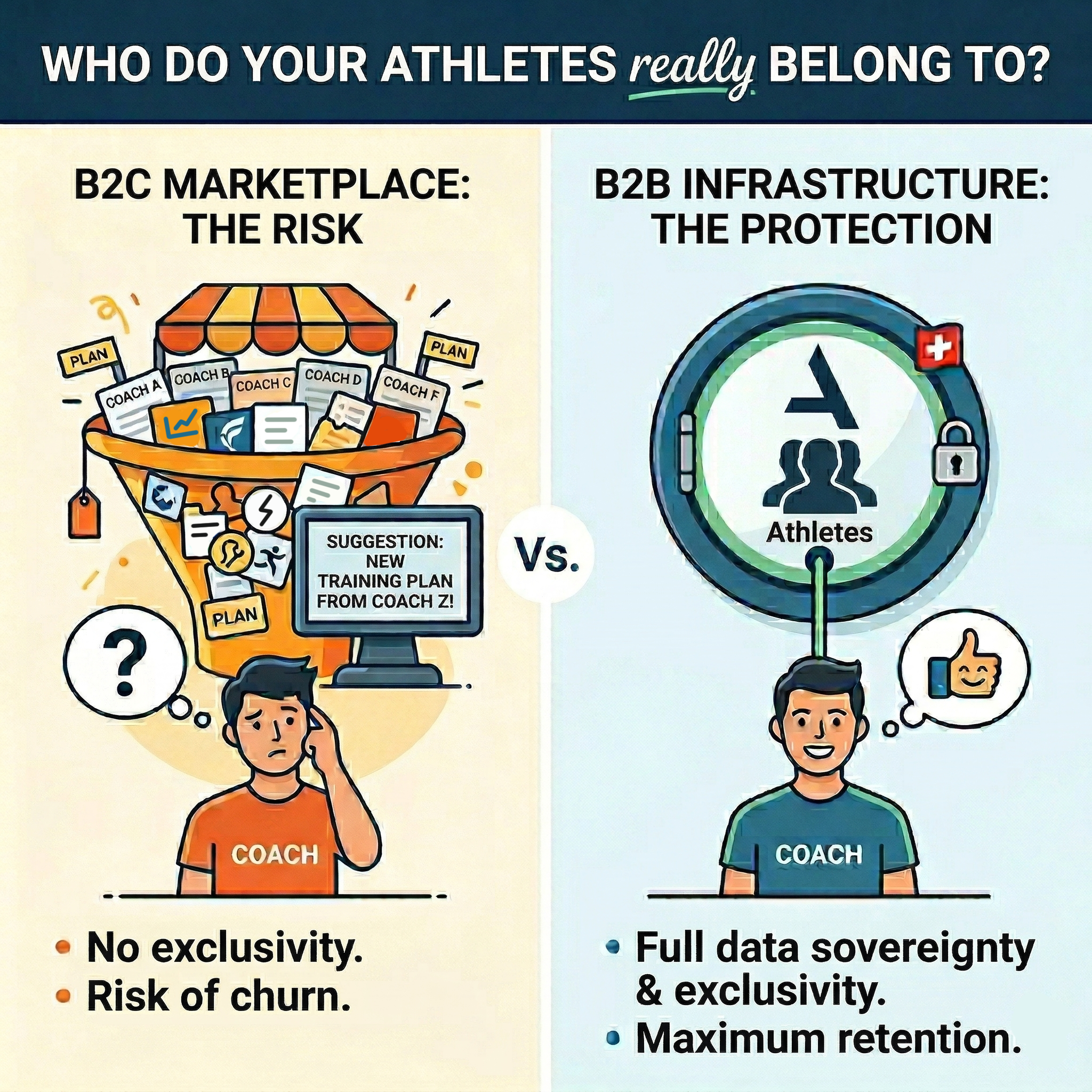
Just as classic %FTP zones can be deceiving, the business model of many well-known training platforms is often deceiving as well. Most common systems on the market (such as TrainingPeaks or MATS) operate as an open B2C (Business-to-Customer) model. For you as a coach, this harbors massive, often unrecognized risks. AZUM, on the other hand, pursues an uncompromising B2B (Business-to-Business) approach in the form of a partner model.
Just as you maintain clear control over monitoring your athletes with a 4-zone model, AZUM gives you full control back over your business. The direct comparison shows what this means in practice:
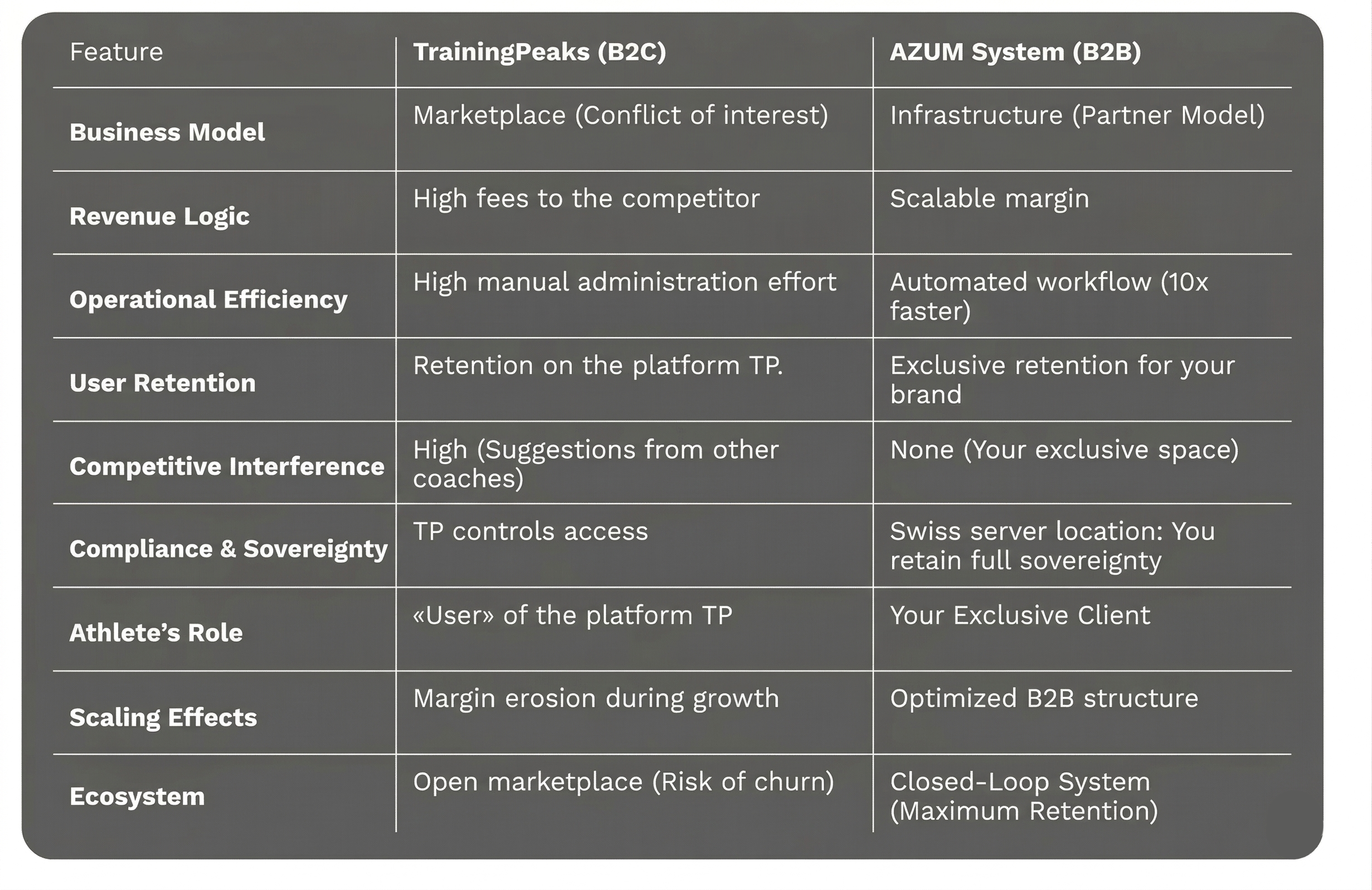
- Business Model
- B2C: The business model is based on an open marketplace. The problem with this is a systematic conflict of interest: The platform wants to make money itself and targets end customers directly.
- B2B (AZUM): AZUM is not a marketplace, but pure infrastructure operating in a partner model. (We provide the technology in the background so your business can shine in the foreground.) AZUM acts as pure infrastructure. We are your software in the background and do not offer any training plans ourselves. We exclusively provide the tools so your coaching business can grow.
- Competitive Interference
- B2C: Competitive interference is high here. In concrete terms, this means: The software actively suggests training plans from other coaches to your athlete. It is like training in a gym where the operator constantly hands out flyers from your competitors to your clients.
- B2B (AZUM): With AZUM, there is no interference. The platform is your exclusive space. Your athlete only sees you and your content.
- Role of the Athlete
- B2C: In a marketplace model, the athlete is primarily a “user” of the respective platform. You are merely the service provider operating on this third-party platform.
- B2B (AZUM): With AZUM, the athlete is your exclusive client. The software only serves as a tool between you and your protégé.
- User Retention
- B2C: Since the athlete is a user of the platform, a bond inevitably forms with the platform itself. If you switch software, it is hard to take the athlete with you.
- B2B (AZUM): AZUM ensures an exclusive bond to your brand. The athlete identifies with your coaching, not with our software.
- Ecosystem
- B2C: The open marketplace brings a constant risk of churn. One click is all it takes, and the athlete buys a standard plan from another provider.
- B2B (AZUM): AZUM operates as a closed ecosystem. This protects your business and ensures maximum retention, meaning the long-term loyalty of your athletes to you.
- Operational Efficiency
- B2C: Many conventional systems require a high level of manual administrative effort in coaching.
- B2B (AZUM): To make your business profitable, AZUM offers an automated workflow. This makes your daily work in planning and administration up to 10x faster.
- Revenue Logic
- B2C: As you grow, you often pay high fees or commissions to the exact competitor who also offers their own plans on the same platform.
- B2B (AZUM): AZUM’s partner model offers a scalable margin for your own brand. Your financial success stays with you.
- Scaling Effects
- B2C: Due to the aforementioned fees and manual effort, growth often leads to margin erosion. This means: The more athletes you coach, the lower your percentage profit becomes.
- B2B (AZUM): AZUM absorbs this problem with an optimized B2B structure. Here, growth also means real, scalable added value for your business.
- Compliance & Sovereignty
- B2C: In a marketplace system, the platform ultimately controls access and thus indirectly the access to your athletes.
- B2B (AZUM): Thanks to the Swiss server location, you retain full sovereignty over your data and that of your clients. No one else has access to your most important asset.

Conclusion: Stop getting lost in rigid systems—whether with training zones or your software. Your coaching business is as individual as the metabolism of your athletes.
Use AZUM’s B2B infrastructure to bind your athletes exclusively to you, strengthen your brand, and grow without margin erosion.