
Training zones are an excellent tool for monitoring, but they often act as a corset that is too rigid for individual training programming. We are solving exactly this dilemma with the latest update to the metabolic profile in AZUM.
We are ending the “forced marriage” between training intensity and training zones. Effective immediately, training intensities (for programming) and monitoring zones (for analysis) are two completely separate technical constructs. What this means for you: You can plan the input with total freedom, without having to compromise on the output.
The problem with existing systems
In many tools – and until now, in our system as well – a defined training intensity (e.g., “10k Race Pace”) always had to be assigned to a specific zone (e.g., “Zone 4”). In coaching practice, however, this model quickly reaches its physiological limits:
- Athlete A (Pro): Can run their 10k race pace at the anaerobic threshold. For them, this intensity is physiologically located in Zone 4.
- Athlete B (Beginner): Runs their 10k significantly slower, well below the threshold. For them, the “10k race pace” might still fall within Zone 3.
If a system forces “10k Race Pace” to always be linked to Zone 4, the programming for Athlete B no longer aligns with their physiological reality. Until now, you had to build workarounds or simply accept these inaccuracies.
The Solution: Full decoupling for maximum precision
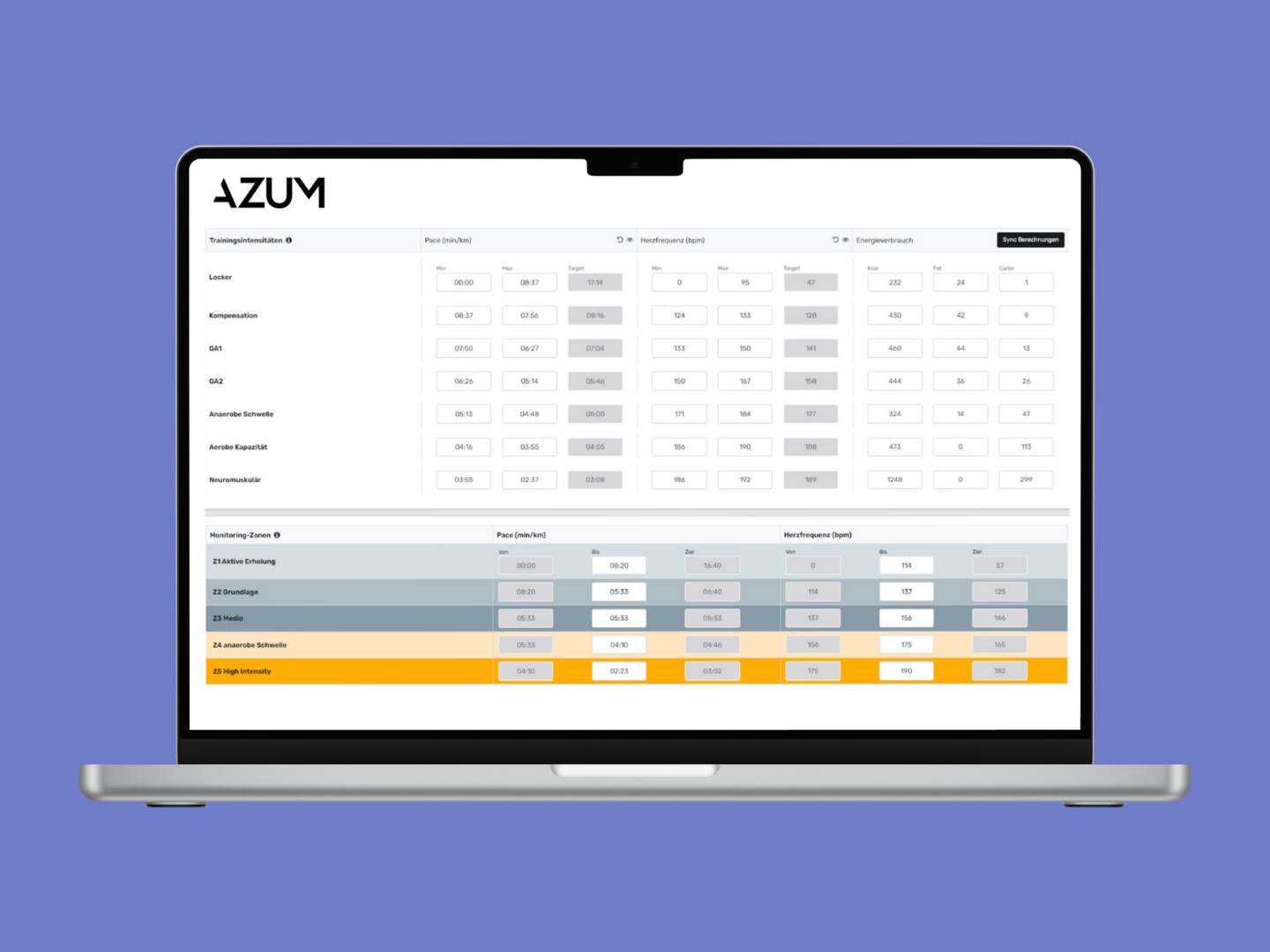
With the new update, you define intensities and zones independently of one another. You can think of them as two separate, autonomous layers:
- Training Intensities (Your Programming): This is where you define the prescriptions for your workouts (e.g., “VO2max Intervals,” “FatMax,” “Race Pace”). You set exact power, pace, or heart rate values used to create the sessions. These values no longer have to be forced into a fixed zone grid.
- Monitoring Zones (Your Analysis): This is where you determine how the completed session is evaluated. You continue to work with your preferred model (3-zone, 5-zone, etc.) to calculate physiological load – completely independent of the name of the intensity you planned.
Your advantage in daily coaching
This clean separation allows you to reach a new level of personalization:
- Zero compromises: You no longer have to decide whether an intensity “wrongly” belongs in Zone X or Y just to satisfy the system.
- Sport-specific: For every athlete and every discipline (running, cycling, swimming), you can define exactly which intensity corresponds to which performance value.
- Precise Control: You plan the training based on exact intensities, yet you analyze the impact based on physiological zones.
- Training plans that work: Your training plans are precisely tailored to your athletes. You control intensities accurately and individually through the Metabolic Profile.
Whether you are a follower of the 3-zone model or prefer a complex 7-zone system – the new metabolic profile adapts to your philosophy, not the other way around.
Want to see how this works in practice?
We’ve created a short video showing you how to set up the new metabolic profile in just a few clicks and start using it for your athletes.